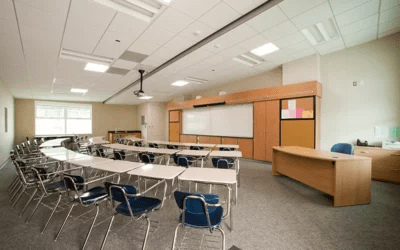
Physical Environment and its role in learning.
The learning spaces among students determine the effectiveness with which they receive information, socialize with other students, and interact with teachers. Although curriculum and instruction are extremely important, the built environment silently constructs everyday experiences. Attention, mood and productivity have a quantifiable impact on lighting, especially. Classes with a lot of artificial lighting are often claustrophobic and exhausting, particularly when school hours are very long. With the use of natural lights in the form of skylights, the atmosphere will change dramatically to provide an environment that would be open, refreshing, and conducive to academic development.
The Effect of Daylight on Education and Learning.
Natural light has biological and psychological implications on the performance of students. Daylight exposure aids in the regulation of circadian rhythms that determine alertness and quality of sleep. When students are provided with sufficient natural lighting during the daytime, they are more likely to stay focused and maintain steady energy levels. Research examining the Impact of Daylight on Education & Learning has consistently linked well-lit classrooms with stronger academic results, improved attendance, and higher levels of concentration.
Daylight also supports emotional balance in addition to measurable performance outcomes. Bright, naturally lit rooms can help reduce stress and encourage a more positive outlook. Even subtle improvements in mood and physical comfort can significantly influence engagement and overall success in educational environments where students often face academic and social pressures.
The way Skylights enhance the classroom lighting.
The classic classroom layout usually relies on the use of windows on the exterior wall. Though useful, these windows are not always able to spread the light in the room. Several areas that are more distant will be darker so that artificial lights even in broad daylight may be needed. This issue is mitigated by having skylights that inject light into the room, and it is thus distributed more evenly on desks, whiteboards, and any collaborative area.
The effects of overhead daylight are minimization of harsh contrasts and minimization of shadows, which may cause eye strain. In order to regulate glare and heat, modern skylight systems are crafted using diffusers and sophisticated glazing to ensure that natural light is used to provide comfort and not distraction. The outcome is a harmonious and aesthetically comfortable learning space that accommodates individual and collaborative education.
Improving the Well-Being and Engagement of Students.
The feeling of being in a light, naturally lit classroom looks totally different as compared to the one that is lightened only by fluorescent fixtures. Skylights provide a feeling of transparency and openness to the outside even in interior designs of a building. This mild association with the cycles of nature will make the students feel less enclosed and more relaxed.
Better quality of lighting also helps visual health. Students spend more and more time in front of screens and printed materials, which makes the minimization of glare and unpleasant artificial light all the more significant. Daylight offers a more dynamic and softer source of light that can lessen the fatigue and allow long-term attention during the school day.
Educators usually note that learners seem to be more active and responsive in the bright areas. The physical environment should be comfortable and welcoming so as to promote participation, creativity and collaboration. The Skylights can be used to develop the qualities through the classrooms into a natural stimulating environment.
Shared and Common Areas Transformation.
The effect of daylight is not limited to individual classrooms. The multipurpose rooms, cafeterias, libraries, and hallways are the key to the daily life of the school. However, such spaces often do not have sufficient natural light. These shared spaces can be enhanced dramatically using skylights so that they might appear safer, friendlier and more useful.
Natural light in the libraries sets a peaceful ambience in the libraries where people read and do research. It creates a casual atmosphere in the cafeterias where students have an opportunity to rest during breaks. Gymnasiums and other large spaces have the benefit of wide and uniform lighting that eliminates the use of high-intensity artificial lights during the daytime. These enhancements do not only improve aesthetics but also the general user experience.
Underwriting Energy Efficiency and Sustainability.
Schools are increasingly under pressure to be sustainable with limited budgets. A great part of the energy used in a school is lighting. With the inclusion of Daylight Solutions in the building design or renovation projects, schools will be able to minimize the use of artificial light during the day.
Skylights when coupled with automated lighting controls enable interior systems to scale along the available natural light. This is a strategy that reduces electricity consumption, minimizes the operational expenses, and promotes long term sustainability objectives. The new systems of skylight are also developed to be thermal efficient and reduce unnecessary heat emission as much as possible but maximize the amount of light produced. Consequently, schools will be able to not only be energy efficient but also provide a better indoor comfort.
Modern Technology and Design Dynamism.
The modern skylight technology has been flexible to meet different architectural requirements. In situations where it may not be possible to have natural lighting, tubular daylighting devices can be used to introduce natural light to interior rooms. The bigger systems are able to light up big areas using well-designed glazing that absorbs UV rays to reduce glare.
School environments are very important in terms of durability and low maintenance. The new installations are designed to resist weather conditions and provide a stable performance with time. Proper planning also makes sure that daylight is brought in strategically to increase functionality as well as the architecture without interfering with daily activities.
The Value of Expert Guidance
The ability to incorporate skylights in learning institutions is an exercise that needs careful evaluation and professional skills. The orientation of the roof, building design, and climate are some of the factors affecting performance. The evaluation of these variables is conducted by organizations such as Daylight Specialists in conjunction with architects and school administrators to provide specific solutions that are in line with institutional objectives.
Skylights do not just serve as architectural elements, but through design and implementation, they are more than that. They are a strategic healthful, more efficient learning environment investment.
A brighter tomorrow for educational spaces.
With the process of school development, the role of establishing enabling and motivating conditions is more pronounced. Natural light is one of the most influential factors in the design of the education arena. Skylight is an easy-to-use solution, forward-thinking, and improves academic outcomes, well-being, and sustainability goals.
Schools can create conducive learning environments by redesigning the interior spaces using balanced daylight, and this would make the schools feel energetic, focused and motivated to learn. When this is done, skylights are useful in creating learning environments which can not only sustain current demands but also promote future prosperity of generations of learners.