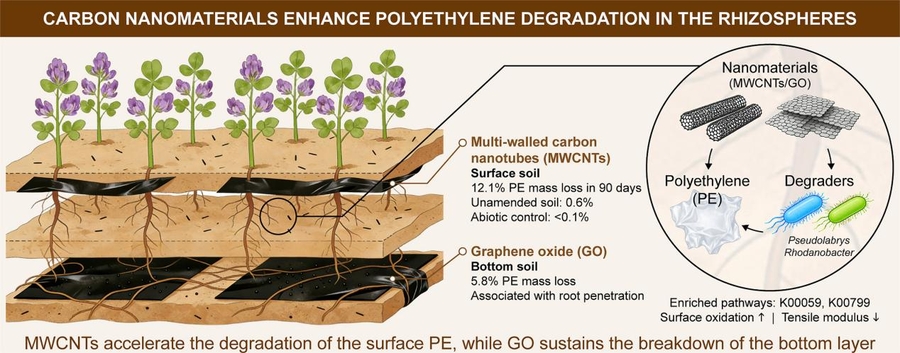
KNOXVILLE, TN, October 09, 2026 /24-7PressRelease/ — A 90-day soil-plant experiment shows that carbon nanomaterials can prime alfalfa rhizospheres to accelerate polyethylene (PE) biodegradation. The study compared multi-walled carbon nanotubes (MWCNTs) and graphene oxide (GO) at different doses and two soil depths, tracking plastic mass loss, surface chemistry, mechanical strength, plant growth, and microbial communities. By linking nanomaterial type to time- and depth-dependent degradation patterns, the work offers a proof-of-concept strategy for tackling recalcitrant plastic waste in contaminated soils while reducing PE phytotoxicity. It also identifies microbial taxa and predicted metabolic functions linked to enhanced breakdown. The results suggest a tunable route for nanomaterial-assisted rhizoremediation.
Polyethylene (PE) accounts for about 60% of global plastic waste and persists in soils because of its chemical inertness. Conventional remediation, including incineration and landfilling, is energy-intensive and can create secondary pollution. Plant-based approaches are low-cost and ecologically compatible, but quantitative PE degradation remains slow: wheat-soil systems lost only 2.8% over 100 days, and soybean rhizospheres degraded about 8% of poly(butylene adipate-co-terephthalate) (PBAT) microplastics over 70 days. Carbon nanomaterials (NMs) can accelerate pollutant breakdown in simplified laboratory systems, yet their performance in complex soil-plant systems, over time, and across soil depths is poorly understood. Given these challenges, deeper research is needed into how carbon NMs behave in planted soils and whether they can safely enhance PE rhizoremediation.
Researchers at University College London (UCL), Department of Civil, Environmental and Geomatic Engineering, conducted the study, published (DOI: 10.1016/j.ese.2026.100772) online on 23 September 2026 in Environmental Science and Ecotechnology. The team used a 90-day alfalfa-soil experiment to test MWCNTs and graphene oxide (GO) for PE degradation, tracking PE mass loss, surface chemistry, mechanical strength, plant growth, and microbial community changes.
In unamended planted controls, PE loss remained low: 0.6% at the surface and 1.2% at the bottom after 90 days. Without plants, PE plus NMs showed no detectable degradation. MWCNTs produced the strongest surface effect, reaching 12.1% loss at 200 mg kg-1 after 90 days and 9.1% by day 30, while bottom-layer loss plateaued near 6%. GO was weaker overall but most effective at 150 mg kg-1, reaching 7.0% at the surface and 5.8% in the bottom layer by 90 days. Mechanical testing showed pristine PE at 782.8 ± 0.3 MPa; planted treatments reduced modulus to 23.2 MPa at the bottom and 19.6 MPa at the surface, with multi-walled carbon nanotubes (MWCNTs) causing the greatest loss. Fourier-transform infrared (FT-IR) and X-ray photoelectron spectroscopy (XPS) indicated surface oxidation, with an O 1s/C 1s ratio of 0.49 in surface films from the plant–MWCNT treatment versus 0.17 for pristine PE. MWCNTs enriched early degraders such as Pseudolabrys and Oleiharenicola and predicted Kyoto Encyclopedia of Genes and Genomes (KEGG) ortholog K00799, whereas GO sustained Rhodanobacter and Gemmatimonas and K02003. PE alone reduced germination potential by 32–35% and germination rate by 16–18%; NMs alleviated this phytotoxicity.
The authors said the key advance was separating rapid surface chemistry from slower root-driven processes. They said MWCNTs appeared to act almost like an early catalyst at the surface, while GO supported a more sustained microbial response deeper in the soil. They also said the plant was essential: without alfalfa, no measurable PE degradation occurred even with nanomaterials. They added that the results are a proof of concept, not a field-ready recipe, because dose, soil type, nanomaterial fate, and non-target effects still need testing.
The findings point to two possible applications. MWCNTs may suit short-term, intensive cleanup of surface-contaminated hotspots, where rapid oxidation and mass loss are priorities. GO may be better explored for longer, deeper soil restoration in synergy with plant roots, especially at optimized doses. But the study also found lower insect-trap counts in most nanomaterial treatments, signaling possible non-target effects. Dose optimization, worker-safety controls, cost reductions, and life-cycle assessment are needed before field use. Commercial PE films also contain additives such as carbon black, whose interactions with nanomaterials and degradation intermediates require further study. Together, these findings highlight the need to balance degradation efficiency with ecological safety.
References
DOI
10.1016/j.ese.2026.100772
Original Source URL
https://doi.org/10.1016/j.ese.2026.100772
Funding information
This work was supported by funding for high-throughput analysis from Artesc Bioscience, The Netherlands. UCL Civil, Environmental and Geomatic Engineering for financial support covering other experimental materials, facilities, personnel, and publication costs.
About Environmental Science and Ecotechnology
Environmental Science and Ecotechnology (ISSN 2666-4984) is an international, peer-reviewed, and open-access journal published by Elsevier. The journal publishes significant views and research across the full spectrum of ecology and environmental sciences, such as climate change, sustainability, biodiversity conservation, environment & health, green catalysis/processing for pollution control, and AI-driven environmental engineering. The latest impact factor of ESE is 14.3, according to the Journal Citation ReportsTM 2024.
Chuanlink Innovations, where revolutionary ideas meet their true potential. Our name, rooted in the essence of transmission and connection, reflects our commitment to fostering innovation and facilitating the journey of ideas from inception to realization.
Related Link:
http://chuanlink-innovations.com
—
For the original version of this press release, please visit 24-7PressRelease.com here
Legal Disclaimer: The content on this page is syndicated from independent third-party providers. Kyrion Media makes no warranties or representations regarding the accuracy, completeness, legality, or reliability of the information, including text, images, videos, or licenses. If you are affiliated with this content or have any complaints, copyright concerns, or requests for removal, please contact us at [email protected] with the specific URL of the content in question. We will review and address valid requests promptly.