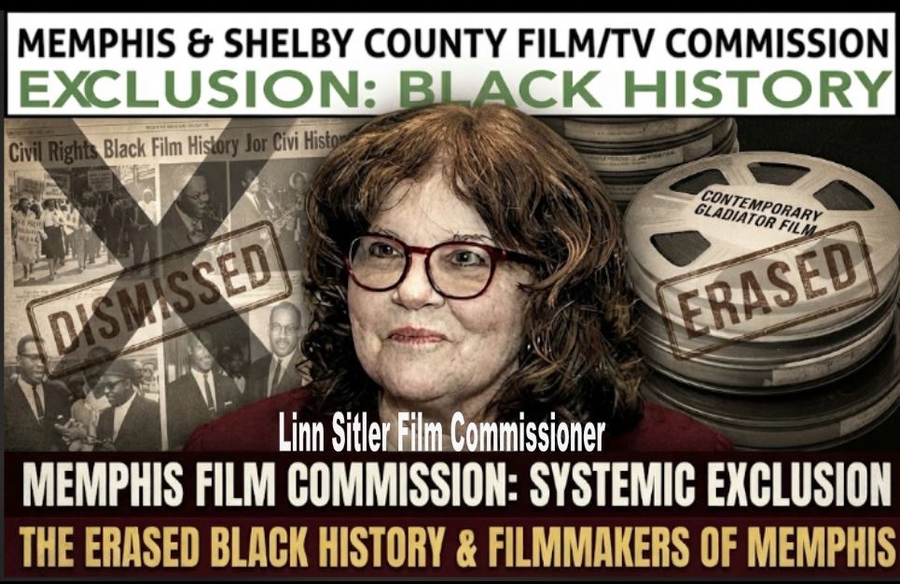
MEMPHIS, TN, October 13, 2026 /24-7PressRelease/ -Please note to readers this story is more than a news story whereas this is a Black Memphis History dossier. The question that one should ask about the tenure of Memphis Shelby County Film Commissioner why is it that “To date in Memphis in 2026 why, no other Black-produced feature film has been identified in Memphis film history that was produced by a Black-owned film company, directed by a Black filmmaker, and received a theatrical release.
Click here to view the 30 minute Video titled: Gale Jones Carson Memphis Film Commission Racism
Therefore, The Contemporary Gladiator (1988) occupies a unique place in Memphis film history” whereas Linn Sitler used her function and authority to erase the only Black Theatrical Film Release in Memphis film history, whereas the Memphis Shelby County Film Commission racism is the reason there has never been a Black produced theatrical film release in Memphis film history other than “The Contemporary Gladiator.”
Learn more click here to view the You Tube Video Titled: Memphis Film Commission Racism .Com
At the corner of G.E. Patterson and Main Street in Memphis White Memphis Film Commissioner implemented Memphis greatest display of White Supremacy Racism in Black on Black Racism via her White Supremacist Racist filmmaking Historical Marker. The marker sits a rock’s throw from the Civil Rights museum where Dr. Martin Luther King Jr. gave his life fighting for Justice whereas Linn Sitler used her function and authority and her Memphis White Supremacist license to erase Black Memphis film history whereas Anthony “Amp” Elmore is the 1st in Memphis to write, produce, direct score and star in Memphis 1st independent 35mm Theatrical film release titled the Contemporary Gladiator released and documented via the IMDB or “Internet Movie Data Base” as a 1988 Film Release. Mystery Train is listed as an 1989 film Release.
Linn Sitler used racism and white supremacy to erase the 1988 Black Film Release: “The Contemporary Gladiator” and name the 1989 Film release Mystery Train instead of naming the 1988 Black Orange Mound Film release the Contemporary as Memphis 1st Independent 35mm theatrical Film release. Linn Sitler transformed the Memphis Film commission into a beacon of White Supremacy, racism and Black on Black racism. A culture that limits Black films and Black Filmmakers.
The question historians will ask; how is it in Memphis, Tennessee in 2026 whereas Memphis is the most populated city of Blacks in America why Blacks in Memphis accept and live with the Memphis and Shelby County film commission’s racism who has an absolute record of “White Supremacy” and Racism. The Memphis and Shelby County Film Commission in Memphis has a 100% record of Black film theatrical release omission. In the history of filmmaking in Memphis the Memphis and Shelby County Film Commission does not list one single Black produced film of an African/American writer, producer director whose film has a “Theatrical Film Release.”
In regards to Memphis, Tennessee; Memphis, Tennessee is the “most MAGA Friendliest Black populated City in America.” This claim was confirmed America’s MAGA President Donald J. Trump who complimented Memphis and its Black Memphis Mayor Paul Young.
When President Trump spoke about Memphis and Black Memphis Mayor Paul Young—particularly during his remarks and visit surrounding federal and task force interventions—his messaging focused on specific claims regarding crime and local leadership and how he loves Black Memphis Mayor Paul Young.
The actual comments and phrasing used by President Trump include: Calling the Black Memphis Mayor “Terrific”: During remarks at the Memphis Air National Guard Base, President Trump publicly praised the Black Memphis local leadership, explicitly stating, “Your mayor has been terrific, and thanking Black Memphis Mayor Paul Young regarding the work of the Memphis Safe Task Force.”
President Trump has repeatedly asserted that federal assistance and task force operations are what successfully drove down crime rates in Memphis. In earlier announcements regarding federal deployments, President Trump stated that local officials and mayors were “happy” to receive federal and National Guard assistance to clean up crime. Memphis Mayor Paul Young later publicly clarified that while he is willing to work pragmatically with any partner to get results, saying he actively requested or fully “supported” military-style deployments was an overstatement.” President Trump endorsed Black Memphis Mayor Paul Young as terrific.
Joking About Moving/Tennessee: President Trump in various political rallies and informal statements discussing states with conservative governance or areas he visits, President Trump has frequently made off-the-cuff remarks about liking certain states so much he “might move there,” though these are generally rhetorical expressions rather than literal plans.
President Trump praised Mayor Young as “terrific” for cooperating with federal task forces, the administration’s framing of total local endorsement has often differed from the nuanced balancing act local Democratic leaders like Black Memphis Mayor Paul Young have had to strike between accepting federal law enforcement resources and responding to community concerns.
The Most important fact regarding Memphis is; “Memphis is MAGA Friendly.” Memphis has a “Cotton Museum and no Black Memphis History Museum.” In America Memphis has the proud MAGA distinction as the city where “King was Killed and Elvis is King.”
Click here to view the video Titled: Orange Mound Black Filmmaking Building Community Via Filmmaking
The Sitler-Jarmusch Diversion: Rather than honoring Elmore’s indigenous local milestone, White Memphis Film commissioner Linn Sitler used her public authority and tax dollars to prop up the White Jim Jarmusch’s 1989 film Mystery Train (backed by billion-dollar Japanese conglomerate JVC) and manufactured a tokenized “black hero Alonzo Woods” narrative for administrative compliance, completely erasing Anthony “Amp” Elmore’s groundbreaking Memphis filmmaking contributions to World Film history. Linn Sitler has the power in Memphis to erase Anthony “Amp” Elmore who is a Filmmaker and credit Black Shelby County emploee Alonzo Woods via his name on a historical Marker.
Memphis Film Commissioner Linn Sitler posse enormous power and Influence in Memphis whereas she can use tax dollars to honor herself and choose her own Negro leader as she put Alonzo Woods a a Filmmaking Historical Market whereas Alonzo Woods never held a film camera or made any contribution the the film culture in Memphis. He is only a Shelby County employee whom Linn Sitler has the power to choose her own Negro leaders.
In 1978 during the Memphis police and fire strike “The Wall Street Journal” called Memphis A backwards city with a plantation mentality whereas the City of Memphis continues to operate via “The plantation System.” Linn Sitler is called by Blacks “Ms. Linn”
See the story of “Ms ANN” AKA Linn Sitler the White Matriarch Linn Sitler who is the most powerful and influential White Woman in Memphis who runs the Memphis Memphis Film Commission like a “Plantation.” No Black leader in Memphis has the courage and wherewithal to challenge “Ms Ann.” Ms Ann Linn Sitler manages the White Supremacist racist Memphis Shelby County Film and Tape Commission as an owner of the Memphis Film Commission.
The Memphis Shelby County Film Commission gets nearly a 1/2 million dollar budget and Linn Sitler has “Carte Blanche” over the Memphis Shelby Film Commission whereas elected officials have no idea what her role is. Linn Sitler takes the tax payer budget and created her own public profile as a Memphis film Celebrity. She spoke at the Collierville Chamber of Commerce and calls herself “The Deal Maker.”
The deal she made was getting millions of tax payer dollars for the failed 2019 NBC television drama Bluff City law. In 2023 Memphis signed a 4-year deal for the NBC television series “Young Rock” aiming at 52 episodes. NBC cut the show short after a single season and Memphis tax payers were stuck with the loss.
Because the series was axed shortly after wrapping its local season, Memphis taxpayers essentially kissed that public money goodbye with very little long-term television infrastructure or sustained local industry to show for it.
In regards to Linn Sitler’s campaign to Bamboozle the Memphis public she creates her own statistics whereas the City of Memphis has not had a successful movie in two decades.
Words are not enough to explain the Memphis culture of White Supremacy, Racism and Black on Black Racism whereas “Action Speaks louder than words” whereas “The Records speaks for themselves.” The key to Memphis White Supremacy, Racism and what is described as “Black on Black Racism” the technical and historic word described by Booker T. Washington is “Black Accommodationist.” Black accommodationist is a political and social strategy where marginalized community leaders, institutions, or power brokers choose to cooperate with a dominant, white-led power structure rather than directly confronting or dismantling systemic inequalities.
It is a documented record whereas Gail Jones Carson a Black woman serves as a VP on the Executive Committee of the NAACP Memphis Branch and Gale Jones Carson served as the chair of the Shelby County Democratic Party, making history as the first woman (and first female African American) to hold that local party leadership position. Additionally, her extensive political involvement includes being elected multiple times to the Democratic National Committee (DNC) and serving on the DNC’s Southern Regional Caucus Executive Committee.
Gale Jones Carson serves as the Chairman of the Board (Board Chairwoman) for the Memphis & Shelby County Film and Television Commission. In this leadership position, she oversees the board and helps guide the commission’s mission to support, promote, and attract film, television, and media production to the Memphis and Shelby County area. This is an absolute fact regarding Memphis Film History: in Memphis film history there has never been a Memphis Black produced film, directed by an African/American whereas the film achieved a “Theatrical Film Release.”
The 1988 Black Produced Film “The Contemporary Gladiator” is not only Memphis 1st 35mm Theatrical Film Release “The Contemporary Gladiator” is the 1st is the 1st Kickboxing film in World Film history whereas Gale Jones Carson is the Memphis Shelby County Film Commission greatest accommodatonalist who assisted an erasing Anthony “Amp” Elmore’s Black Memphis Film history.
In regards to the Memphis Shelby County Film Commission racism this culture and practice is a part of the Memphis Culture of “Black on Black Racism”
Respectfully Elmore’s aim is not to bash the late Black Tennessee State Representative G.A. Hardaway who passed away on April 24, 2026. Anthony “Amp” Elmore explains that my relationship with G.A. Hardaway goes back decades. Anthony “Amp” Elmore and G.A. Hardaway work together on the 2002 Randy Wade Campaign For Sherriff. Elmore in the Carpet business installed Carpet in rental property for G.A Hardaway years earlier.
Anthony “Amp” Elmore remembers his last conversation with the late G.A. Hardaway whereas the conversation is document and can be confirmed by noted Memphian Randy Wade. Elmore told G. A. Hardaway that it was unconscionable that as a friend and brother he was aware that Elmore produced the movie “The Contemporary Gladiator” in 1988 whereas he as our duly elected representative of Orange Mound had a moral obligation as our representative to get our film noted in the State of Tennessee whereas in 1988 Tennessee Governor Ned McWherter recognized the film sending Elmore Governor Film award proclamation. Elmore loss the proclamation via house fire in 2003.
This is the story whereas Anthony “Amp” Elmore went to Kenya and met with governors whereas those Governors came to Memphis via a crooked deal arranged by G.A. Hardaway. The story made news in Kenya whereas President Obama did not visit his family’s home town because of the crooked deal arranged by G.A. Hardaway and Kenyan leaders.
Please click here to see the video titled: Why President Obama did not Visit Siaya County in Kenya
Per the video you will see how Tennessee State Representative G.A. Hardaway via a crooked deal with Kenyan Governors and the reason why President Obama did not travel to his family home in Siaya County in Western Kenya.
In 2019 Gale Jones Carson used her influence to get G.A. Hardaway and Tennessee State Senator Ramesh Akbari to use their Black political influence and trade off of Black equity to ask for an 18 million dollar grant to support the failed White NBC Television show “Bluff City Law.”
The Memphis Shelby County Film Commission arranged a culture of White Supremacy, Racism and Black on Black Racism whereas Black gatekeepers are put in place to silence and diminish Black history and Black empowerment whereas the Memphis Shelby County Film commission could operate via an unabashed White Supremacy and Racism. Linn Sitler has the aide and support of “Black Accommodationist.”
Anthony “Amp” Elmore used You Tube to document and time and date stamp history and culture. In Memphis, Tennessee party to Memphis White Supremacy and Racism is Black on Black Racism whereas Blacks and Whites unite to preserve White Supremacy via obstructing Black progress. In the case of Toni Holman Turner who worked as public affairs manager for Parks and recreation in Memphis, whereas Anthony “Amp” Elmore needed permission to film at the “Orange Mound Community Center.” Toni Holman did not decline Anthony “Amp” Elmore from filming at the Orange Mound Community Center she simply would not answer the request.
Instead of writing down the discrimination Anthony “Amp” Elmore created a You Tube Video and posted the video to give it a certified time stamp and history whereas the Memphis Shelby County Film Commission racism is part of a broader practice of Memphis White Supremacy, Racism and Black on Black Racism.
This is what Black leader Malcolm X Said about the “House Negro and the Field Negro.” The house Negro usually lived close to his master. He dressed like his master. He wore his master’s second-hand clothes. He ate food that his master left on the table. And he lived in his master’s house–probably in the basement or the attic–but he still lived in the master’s house.
So whenever that house Negro identified himself, he always identified himself in the same sense that his master identified himself. When his master said, “We have good food,” the house Negro would say, “Yes, we have plenty of good food.” “We” have plenty of good food. When the master said that “we have a fine home here,” the house Negro said, “Yes, we have a fine home here.” When the master would be sick, the house Negro identified himself so much with his master he’d say, “What’s the matter boss, we sick?” His master’s pain was his pain. And it hurt him more for his master to be sick than for him to be sick himself. When the house started burning down, that type of Negro would fight harder to put the master’s house out than the master himself would.
But then you had another Negro out in the field. The house Negro was in the minority. The masses–the field Negroes were the masses. They were in the majority. When the master got sick, they prayed that he’d die. [Laughter] If his house caught on fire, they’d pray for a wind to come along and fan the breeze.
Clearly the Memphis Shelby County Film Commission operates via the “plantation Culture” based on White Supremacy and Racism whereas there is a culture and practice to rule out most Black Films and Black Filmmakers. The Memphis Shelby County Film commission website reads:
These are the words on the Memphis Shelby County Film Commission Website that exclude most African/Americans: “The Memphis & Shelby County Film and Television Commission, like other publicly-funded film commissions in the U.S.A., works only with funded productions and does not assist producers in securing funding for projects.”
What is disqualifying to most African/American filmmakers are the words “works only with funded productions.” This policy is a racist policy of the Memphis and Shelby County Film and Television Commission—specifically its requirement that productions must already be fully funded to receive assistance.
Linn Sitler and the Memphis Shelby County Film Commission creates a profound systemic disadvantage for Black Films and Black filmmakers whereas Black independent and underrepresented creators, particularly within the African American community are shut out.
Anthony “Amp” Elmore who created Memphis 1st Independent 35mm Theatrical Film “The Contemporary Gladiator” in 1988 is shut out because he is not fully funded. Unknown and untold by Linn Sitler and Gale Jones Carson is the “Black Magic Camera.” Advancements in technology like A.I. has made it possible for an Independent or grassroots Filmmaker to produce a Hollywood film via a “shoestring budget.” In 2026 a filmmaker does not need a fully filmmaking funding, a filmmaker needs “Fully Filmmaking Fundamentals.”
The Memphis Shelby County Film Commission is publicly funded by taxpayers and not owned by Linn Sitler whereas she operates like plantation owner who owns the film Commission and its resources. The Memphis Shelby County Film Commission is not open and accessible to all citizens and local filmmakers, because of their initial financial standing. The Memphis and Shelby County Film and television commission operates via a racist culture of White Supremacy and “Black accommodatonalist who impede Black Filmmaking.”
Independent filmmaking has historically relied on grassroots funding models, personal sacrifice, and resourcefulness rather than immediate corporate backing, as famously demonstrated by iconic filmmakers like Spike Lee and Robert Townsend who utilized family support and credit cards to launch their groundbreaking careers.
Modern technological advancements, such as accessible cinema cameras and digital audio gear, means that a compelling creative person with a vision and a solid foundation matter far more at the outset than upfront capital. Enforcing a strict “funded-only” threshold effectively locks out Black and grassroots artists who are still in the process of building momentum, securing investors, or finishing their projects through community support.
Consequently, rather than serving as an inclusive engine for local talent, the Memphis Shelby County Shelby Film Commission restrictive prerequisite disproportionately shuts out Black creators who lack access to traditional elite financial networks, undermining the core public mission of a tax-supported agency designed to foster art and culture for the entire community.
Click here to visit the website: Memphis Film Commission Racism . Com
The operational framework of the Memphis and Shelby County Film and Television Commission reflects deep-seated systemic issues embedded within broader American and Southern cultural histories of white supremacy and institutional exclusion. Under the long-standing leadership of Film Commissioner Linn Sitler, Anthony “Amp” Elmore argue that the commission has historically functioned as an exclusive gatekeeper, prioritizing major, well-financed, and predominantly white commercial productions while marginalizing independent, grassroots, and minority creators.
This systemic bias is further compounded by a complex political dynamic in Memphis, where local Black elected officials and have often maintained or supported these entrenched administrative structures rather than dismantling them. Consequently, policies that demand upfront funding as a prerequisite for assistance act as an institutional filter, effectively shutting out African American filmmakers who rely on resourcefulness, community backing, and sweat equity.
This exclusionary environment mirrors broader societal patterns where systemic inequality is preserved not only by traditional power structures, but also by political complicity, creating an uneven playing field that stifles diverse storytelling and Black artistic advancement in the region.
White Memphis Film Commissioner Linn Sitler’s greatest MAGA White Supremacist achievement is her erasure of the 1988 Black Memphis Film “The Contemporary Gladiator.” The erasure upholds “White Supremacy” Whereas both Black Memphis and White Memphis must never know that a Black man living in the African/American Memphis Community of Orange Mound is Memphis 1st Independent 35mm Theatrical Film maker.
Linn Sitler was able to use Tax payer dollars to create a historic marker that reads: “On this South Main Street corner in 1988 the modern wave of Memphis movie making was born, in great measure through the efforts of the Memphis & Shelby County Film Commissioner Linn Sitler and Shelby County Government official Alonzo Woods.”
The legacy of longtime Memphis and Shelby County Film Commissioner Linn Sitler is marred by institutional manipulation, self-aggrandizement, and the erasure of Black filmmaking history. Anthony “Amp” Elmore point to public markers—such as the 1988 South Main Street plaque crediting Sitler and county official Alonzo Woods with birthing the modern wave of Memphis filmmaking—as a fraudulent rewrite of history designed to elevate her own profile using taxpayer dollars.
This public relations narrative effectively airbrushed out the pioneering contributions of local African American filmmaker Anthony “Amp” Elmore, who had already been producing independent cinema in the historic Black community of Orange Mound.
By Linn Sitler using her official authority and public funds to craft a self-serving narrative, Linn Sitler institutionalized a system of exclusion that erased vital milestones of Black film history in Memphis, maintaining a personal promotional campaign while denying equitable recognition and support to indigenous minority creators.
Black Filmmaker Tyler Perry built a Multi-Billion dollar Black Film Industry in Atlanta Whereas Memphis most notable Film star is Linn Sitler who has made the Memphis Film Commission the star and not filmmaking and filmmakers.
The tenure of Linn Sitler has effectively turned the Memphis and Shelby County Film and Television Commission inside out, transforming the commissioner herself into the primary star rather than championing the actual filmmakers and artistic talent of the city. Instead of operating as an inclusive engine to discover, nurture, and showcase diverse local directors, producers, and storytellers, the commission has functioned as an instrument for personal branding and institutional spotlight.
By centering public resources, media attention, and institutional prestige around Linn Sitler’s leadership, the agency has prioritized self-promotion and elite commercial optics over the genuine advancement of Memphis cinema. This dynamic has reduced independent, grassroots creators—especially within the African American community—to invisible outsiders in their own city. White Memphis Film Commission Linn Sitler’s actions prove that under this centralized administration, the true beneficiary and headline act of the public film commission has paradoxically become the commissioner herself.
The story tells how Linn Sitler was able to get the show “Bluff City Law to Memphis.” It was Gale Jones Carson who used her political capital to get Black legislators to use Black Capital to fund the White produced show of White Civil Rights attorney whereas the real Memphis Civil Rights were Black, whereas the show was a flop after one season.
Anthony “Amp” Elmore is fighting Memphis White Supremacy, Racism and Black on Black Racism to make Memphis the model City of a film culture rather than one of only a Film Commission as Memphis only film related star.
Anthony “Amp” Elmore has positioned himself at the forefront of a vital struggle against systemic barriers in Memphis, confronting the overlapping pressures of historical white supremacy, structural racism, and political complicity. Rather than accepting the Linn Sitler and Gale Jones Carson model of institutional racism built around exclusion, self-aggrandizement, and gatekeeping, Elmore envisions transforming Memphis into a thriving, inclusive capital of independent cinema.
Anthony “Amp” Elmore’s mission is to shift the local paradigm away from Linn Sitler and the racist elite-focused, bureaucratic “film commission” model that prioritizes corporate budgets and self-promotion, and toward a vibrant, grassroots film culture.
Anthony “Amp” Elmore is advocating for equitable access, honoring true pioneers from historically Black communities like Orange Mound, and demanding that public resources serve all citizens equally, Elmore is championing a comprehensive blueprint to make Memphis a true model city for diverse artistic expression and empowerment away from Memphis accommodatonalist.
The greatest obstacle via Building Community via Filmmaking is Memphis White Supremacy, Racism, Black on Black Racism and “Black Accommodationist.”
In order to fight Memphis White Supremacy, Racism Black on Black and Black accommodatonalist Anthony “Amp” Elmore created Memphis 1st digital Black Memphis History Museum. Click here to visit the website titled: Black Memphis History .Com
While ignored and erased as a filmmaker in Memphis Click here to visit the Anthony “Amp” Elmore video Channel
Anthony “Amp” Elmore face White Supremacy, Racism, Black on Black Racism and Black Accommodatonalist in Memphis Anthony “Amp” Elmore created 1000 you tube videos including 100’s of movies and Black Memphis history documentation whereas via this writing Anthony “Amp” Elmore documents: “Memphis Film Commission Racism.”
About Us
“If Lions were historians, hunters would no longer be heroes.” This powerful African proverb encapsulates the mission of the Orange Mound News Network (OMNN). Founded by Anthony Amp Elmore, OMNN aims to reclaim and reshape the narrative of Orange Mound through the power of filmmaking, education, and content creation. Our goal is to challenge the negative stereotypes and biased portrayals that have long plagued our community, creating a positive space for family, Black culture, history, and education.
Our Journey and Mission
Orange Mound, established as the first community in America built for Blacks by Blacks, has a rich history often overshadowed by negative stereotypes. Mainstream media and societal biases have painted Orange Mound as a “ghetto,” contributing to a 30% decline in property values while surrounding communities have prospered. The Orange Mound News Network was created to counter this narrative and highlight the true spirit and resilience of our community. Anthony Amp Elmore, a five-time world karate kickboxing champion, filmmaker, and community activist, has been a beacon of change in Orange Mound. With over five decades of community service, Elmore has dedicated his life to uplifting Orange Mound. From becoming a homeowner at 19, stablishing businesses, to founding the Proud Black Buddhist World Association, Elmore’s contributions have been immense
Connecting Communities Through Culture and History
Elmore’s journey in cultural diplomacy began when he was invited to Kisumu, Kenya, by Governor Anyang’ Nyong’o to attend FESTAC, the largest African and Black Art festival in the world. It was here that Elmore’s vision for a deeper connection between Africans and African Americans took root. During his visit, he engaged with students at ARYA Primary School, performed a song about Kenya’s founding father Tom Mboya, and proposed a pen pal program that evolved into a robust educational and cultural exchange.
Our journey in African Cultural Diplomacy began in 1990
when the Orange Mound Memphis-produced movie “The Contemporary Gladiator” premiered in Kenya. This marked a significant milestone in Elmore’s mission to foster cultural exchange and understanding. The film’s premiere in Kenya not only showcased Elmore’s work but also solidified his role as a cultural diplomat.
—
For the original version of this press release, please visit 24-7PressRelease.com here
Legal Disclaimer: The content on this page is syndicated from independent third-party providers. Kyrion Media makes no warranties or representations regarding the accuracy, completeness, legality, or reliability of the information, including text, images, videos, or licenses. If you are affiliated with this content or have any complaints, copyright concerns, or requests for removal, please contact us at [email protected] with the specific URL of the content in question. We will review and address valid requests promptly.