By Daniel Whitmore
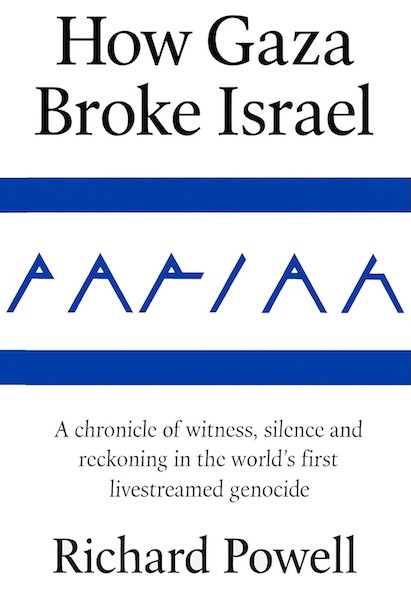
Wars are often described in moral or strategic terms. Richard Powell’s Pariah: How Gaza Broke Israel insists that they must also be examined through the lens of political economy. Beyond the language of security and retaliation, Powell asks a more structural question: who benefits from prolonged instability, and how do financial networks intersect with policy decisions?
This dimension of the book moves beyond battlefield chronology. Powell explores lobbying networks, defence contracts, energy infrastructure and maritime corridors that shape strategic calculations in the Eastern Mediterranean. He does not claim that economic factors alone explain the Gaza war. Instead, he argues that they form a layered backdrop against which political decisions unfold.
The blockade of Gaza remains central to his framework. Restrictions on goods, exports and movement created a tightly controlled economic environment long before the most recent escalation. Powell contends that this economic architecture reinforced political containment.
From there, the analysis widens toward international lobbying and campaign finance, particularly in the United States. Powell references publicly documented political donations and legislative voting patterns, suggesting that financial influence networks contribute to sustained policy alignment. While critics may argue that correlation does not prove causation, Powell’s intention is to illuminate structural relationships rather than single causes.
Energy politics occupies a significant portion of the book’s later chapters. Offshore gas reserves in the Eastern Mediterranean, particularly the Leviathan field, are situated within broader regional power dynamics. Pipeline proposals, export routes and maritime boundary disputes form part of the geopolitical landscape.
Powell suggests that energy infrastructure cannot be separated from security doctrine. Maritime corridors connecting the Mediterranean to global trade routes carry both economic and military significance. In this context, Gaza is not merely a territory under siege; it is located within a strategic coastline embedded in global commerce.
The book also touches on the global defence industry. Arms contracts, replenishment agreements and security partnerships form a dense network of mutual dependency between states and corporations. Powell argues that prolonged conflict sustains certain economic relationships even as it erodes humanitarian conditions.
The financial dimension intersects with media and diplomacy. Powell contends that political messaging often emphasises immediate security imperatives while leaving structural economic considerations implicit. In his reading, this asymmetry shapes public understanding.
International law enters the discussion again here. Legal proceedings at the International Court of Justice and International Criminal Court complicate economic and strategic planning. Once formal allegations are lodged, reputational risk affects not only governments but corporations operating in contested environments.
The tone of this section is investigative rather than polemical. Powell does not claim secret conspiracies. He relies on publicly accessible documentation and structural inference. His argument is cumulative: political economy does not replace moral analysis, it deepens it.
Critics may argue that energy infrastructure and lobbying networks are perennial features of international politics, not unique to Gaza. Powell acknowledges this continuity. His contention is that the Gaza war brought these elements into sharper relief under conditions of global scrutiny.
As contemporary analysis of the Israel–Palestine conflict, Pariah expands beyond conventional diplomatic framing. It situates Gaza within a web of financial interests, trade corridors and energy strategy that transcend regional boundaries.
Whether economic incentives significantly shaped policy choices during the war remains debated. But Powell’s broader insight stands: modern conflicts cannot be understood solely through the language of ideology or deterrence. They unfold within economic systems that both constrain and incentivise decision-making.
By foregrounding political economy, Pariah challenges readers to consider not only what was destroyed in Gaza, but what structural interests endured.
The book is available in ebook, paperback and hardback editions. Readers can find retailer listings, including Amazon, at https://pariahbook.com/, where the first three chapters are also available to download free of charge.